
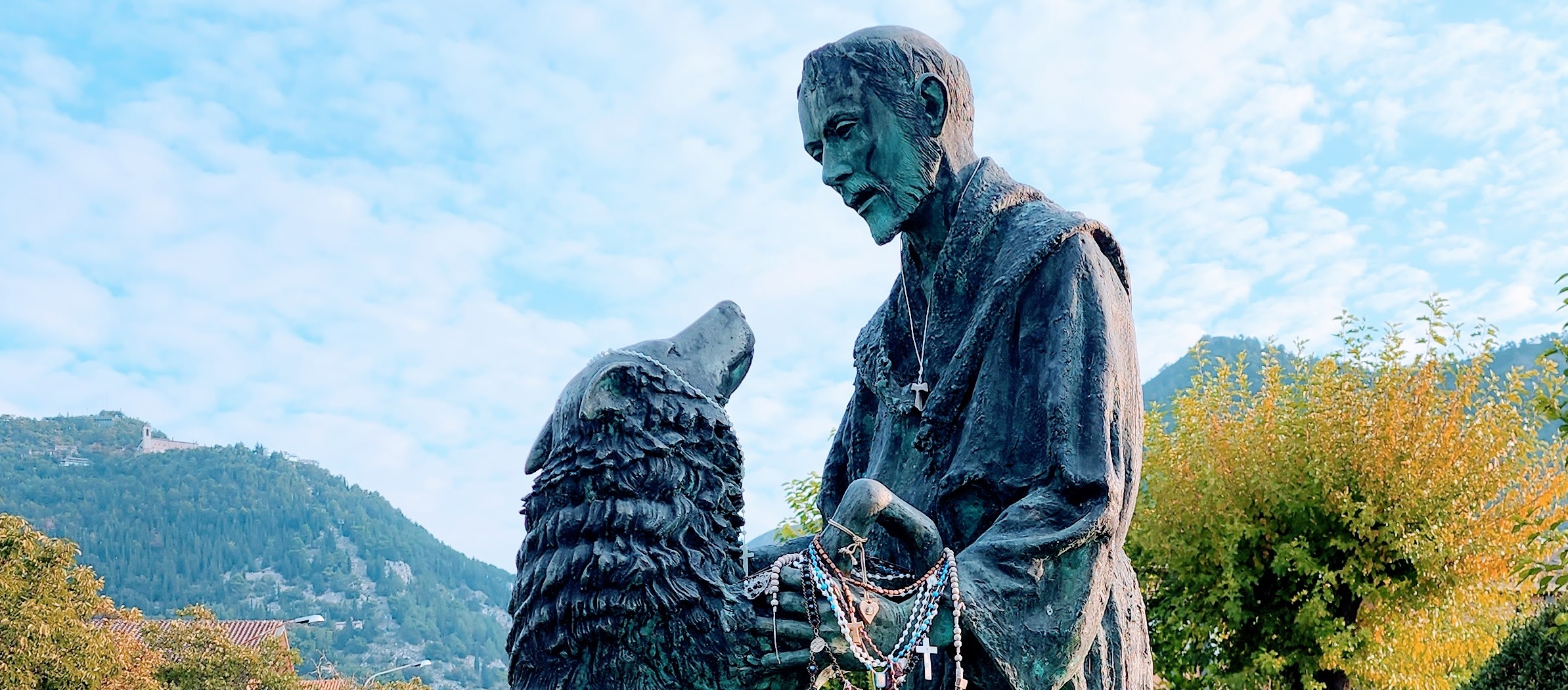
Wolves aren’t known for their popularity, at least not in a good way. Their image has been tarnished over the centuries, to say the least, thanks to unflattering fairy tales, fables and in modern times the culture’s obsession with horror films. No wonder these beautiful wild animals still struggle in the public image category.
No doubt being this is Halloween weekend, once again the wolves will be receiving additional bad press as they’re portrayed on the big screen and in many a costume as frightening man-eating beasts.
But since Halloween, or All Hallows Eve, is historically a Catholic event, which began with the Church preparing for the following holy day, All Saints Day, what if we decided to look at these creatures differently and through the eyes of one of our most beloved saints?
The townspeople of Gubbio, in central Italy, saw a miracle, and not one, but two churches built in memory of a wolf, but it wouldn’t have happened without St. Francis of Assisi.
The encounter between St. Francis of Assisi and the infamous “Wolf of Gubbio” is said to have happened around 1220. Yet even now, standing outside the city walls at the tiny church, built on the spot of the meeting, you can almost feel the tension of the terrified townspeople as they watched Francis approach the ferocious animal. That’s how alive the story is today. This is the one that still receives, by far, the lion’s — or in this case, the wolf ’s — share of attention, even though Gubbio, with its exciting and lengthy history, has much to be proud of in addition to Francis and the wolf.
As the story goes, the wolf had been terrorizing the people of the town, attacking livestock and even threatening local residents — so much so that no one wanted to leave the city, until St. Francis showed up, of course, to take a closer look. Townspeople were so fearful of the ferocious animal that they felt it necessary to arm themselves and decided that if they needed to leave Gubbio, they would not venture out alone.
Against the advice of the locals, Francis decided to go into the woods to meet the animal. St. Francis, feeling great compassion for the people of Gubbio, resolved to go and meet the wolf. Making the Sign of the Cross, and putting all his confidence in God, he went forth from the town, taking his brethren with him. But they feared to go any further.
Francis went alone toward the spot where the wolf was known to be, while many people followed at a distance, and witnessed the miracle. The wolf, seeing all this multitude, ran towards St. Francis with his jaws wide open. As he approached, the saint, making the Sign of the Cross, cried out: “Come hither, brother wolf; I command thee, in the name of Christ, neither to harm me nor anybody else.”
It’s said that when Francis made the Sign of the Cross over the wolf, the creature suddenly changed completely. The wolf, closed his jaws, stopped running, and coming up to St. Francis, lay down at his feet as meekly as a lamb.
Francis then had what you might call a heart-to-heart with the wolf, reminding him that he was destroying and killing God’s creatures without God’s permission. He promised the wolf that if he changed his ways, he would be protected and fed. From then on, the animal lived peacefully among the Gubbio residents, who made sure he was safe and well fed.
There are claims that the wolf lived for a few more years and when he died, he was mourned by the locals. He is also remembered lovingly at another small church inside the city. The narrative of Francis and the wolf of Gubbio may seem like an old wives’ tale passed on through generations. But why then are two churches dedicated to that meeting in the woods?
When you stroll along the lovely medieval streets of Gubbio, you can see and feel the spiritual weight the encounter carries for followers of Francis and especially locals.
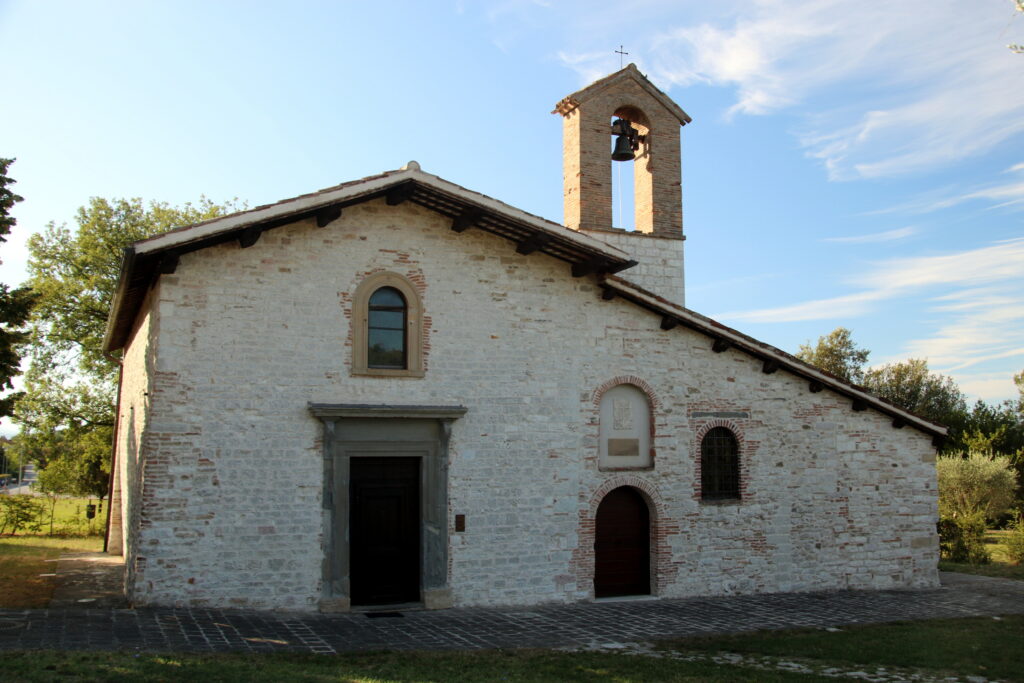
When visitors walk up to the side at the edge of a beautiful park, where nearly eight hundred years ago Francis spoke to the wolf, they notice near the door of Santa Maria della Vittoria an interesting carving reminding them of what happened here. Translated, it states, “Here is where Francis calmed down the wicked wolf.”
Once inside, visitors’ eyes are quickly drawn to the front of the church. On the right side of the altar are two precious statues, one of St. Francis of Assisi and the other of a changed wolf, which has obviously been subdued and appears more like a timid dog than a ferocious beast. Across the street from Santa Maria della Vittoria is a wonderful statue of Francis greeting a very happy creature, his friend Brother Wolf.
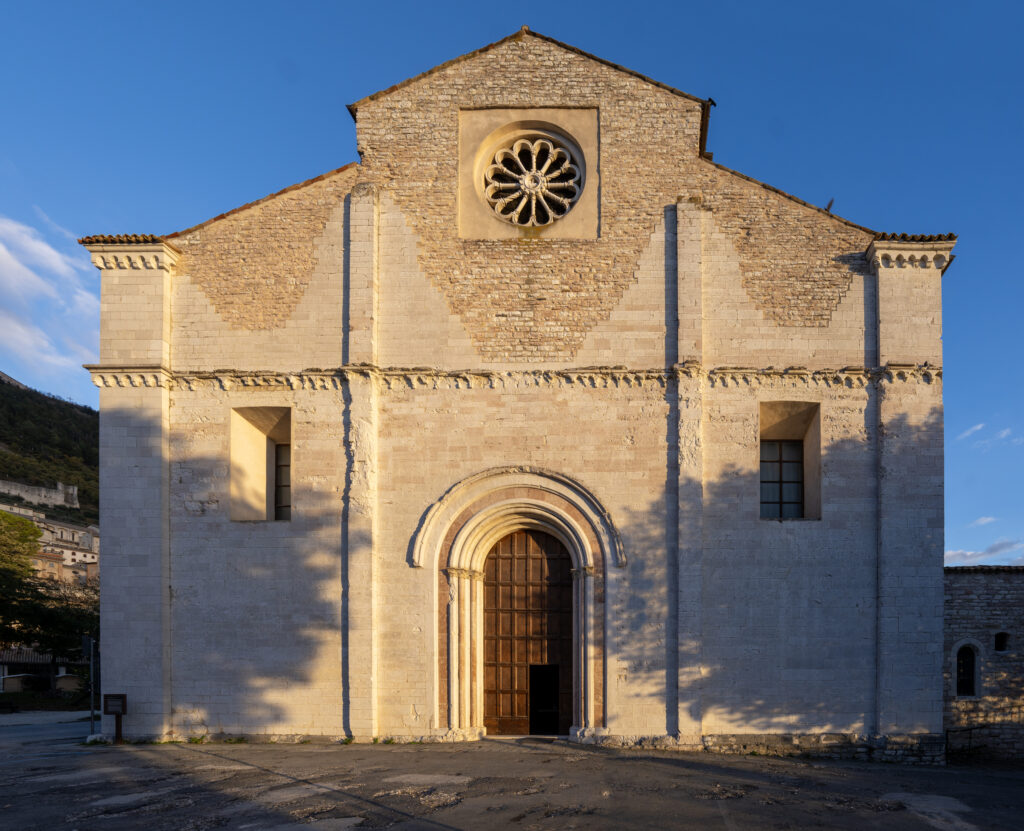
You can take a nice stroll back inside the city, up its steep cobblestone streets, to see the church that tells the end of the story, San Francesco della Pace, or St. Francis of the Peace. Tradition says the townspeople wanted to give the wolf a proper resting place, so it was buried here in the crypt below.
The crypt has several images of the wolf, a storybook version in Italian with colorful illustrations for children, and even a life-size stuffed wolf to admire.
And while travelers are free to see the engaging stories of Francis and the wolf as fiction instead of fact, or a matter of faith, they might have a tough time explaining away what was found here in 1873 during renovation work. Construction workers discovered a tomb containing the skeletal remains of a large canine with a tombstone that remains visible. Still today it is the only known case of an animal buried inside a church.
Sharing the story of the “Wolf of Gubbio” is a wonderful way to celebrate the real meaning of Halloween. No tricks. Just the very special and holy treat of remembering members of that great cloud of witnesses, including St. Francis of Assisi, who help us see the world through all of God’s creatures including a wolf from Gubbio.
St. Francis of Assisi, PRAY FOR US!
Teresa Tomeo Featured on The World Over With Raymond Arroyo
Recently, I was a guest on The World Over with Raymond Arroyo. Don’t miss our great discussion on St. Francis of Assisi, and the places in Italy important to St. Francis that you should not miss! Click Below to Watch.
2026 marks the 800th Anniversary of the death of St. Francis of Assisi. Learn more HERE about this beautiful anniversary and special St. Francis of Assisi Jubilee Year and Celebration designated by Pope Leo XIV.
Note: Portions of this article are excerpts taken from Teresa Tomeo’s Italy’s Shrines and Wonders: Discovering Sacred Spaces and Fascinating Places in the Life of St. Francis of Assisi published by EWTN Publishing.
Photos: Public Domain